You will save yourself a lot of anguish, a lot of fishing time, and maybe even a life if you and your boat are properly equipped with some first aid supplies. (See Boating Regulations by state)
Because once you are out on the water, it is too late to discover that a very important item is missing. This applies whether you are taking that old beat up “John” boat to a farm pond or that brand new Lund to the backwoods of Minnesota.
(This page may contain affiliate links, which means I may earn a small commission if you click through and make a purchase. You can read our Affiliate Disclosure here.)
One Item You May Have Overlooked
I’ve penned another article regarding things both required and needed in your boat in order to have an enjoyable and safe day on the water. Things like PFDs, signaling devices, fire extinguishers, ropes, throw-able cushions, portable VHS emergency radios, etc.
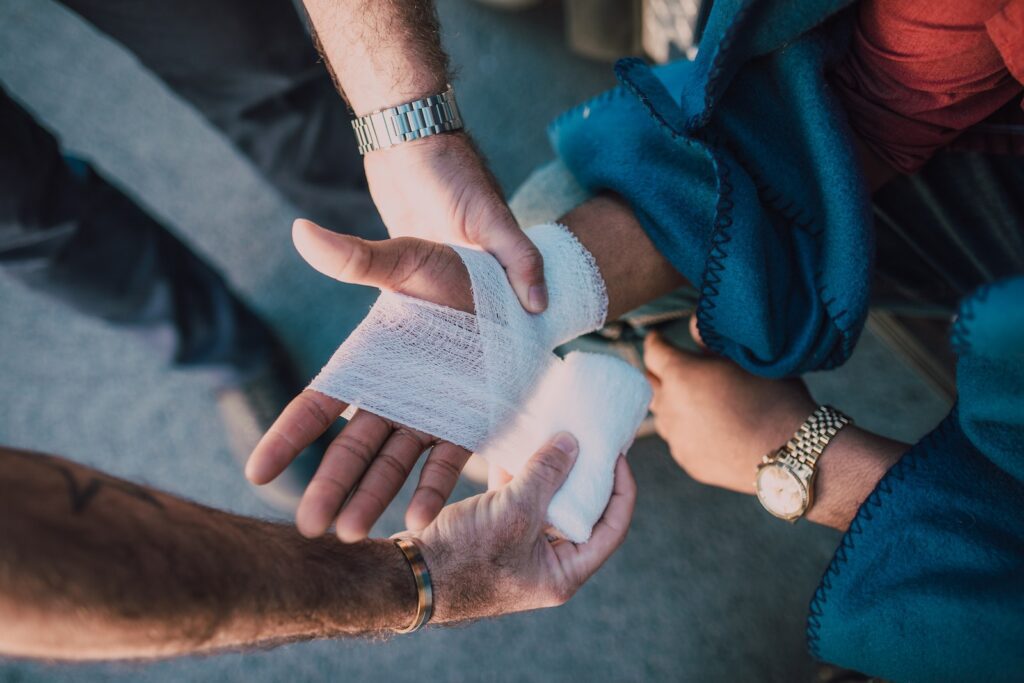
But one item not often thought about and easily overlooked is the basic first-aid kit. How many of you actually have a well-stocked First Aid/Medical Kit on board? Does it have the basic supplies like antiseptic, gauze, tape, band-aides and antihistamines? (You never know how allergic you are to things like stinging insects, until you are far, far from home with no doctor close by). And it certainly wouldn’t hurt to do a little reading on Basic First Aid, or how to remove an embedded fishhook, or stop heavy bleeding.
An onboard medical emergency may never occur. But if it does, do you have the appropriate tools at your disposal? A first aid or medical kit could save a life. It could also – at the least –help to avoid an unnecessary and potentially expensive visit to a hospital in a remote location. A little preparation and planning could make a world of difference.
Questions Before Heading Out
At the very least, there are a number of questions that should at least be considered, if not fully answered before heading out. A lot obviously depends upon where – and how – you do your boating. For example, do you spend the majority of your time on small bodies of water and close to “civilization”? Or is your boat of the variety that you spend the bulk of your time on the ocean or far from land?
And who are the passengers/crew? Are they adults? Children? A mix of both? Does anyone have special needs (special allergies, diabetes, heart problems, etc.) that may be of concern? What communications gear is to be found aboard? Is it sufficient to contact someone in case of an emergency? Note: You can’t always count on your cell phone!
Finally, does anyone have any special training that could be of use? Does anyone have experience with CPR? (And I’m not referring to Catch, Photograph and Release!) Does anyone have any skills at all in basic first aid?
The Right Solution
There is no “standard” kit that is the right one for every boat. You could spend a lot of time, effort and energy trying to assemble a custom first aid kit… Or you could simply get an “off the shelf” kit. You could spend as little as $15 or as much as $1000. As I suggested, a lot depends on where you do your boating and the needs of your passengers and crew. But for about $30 – $40, you can get a kit that will certainly cover most of the bases (available from Amazon, West Marine, or Boat US).
And it wouldn’t hurt to pick up a copy of “Marine Medicine Vol. 2” (also available at West Marine). The cost is about $15, and the book is a guide by doctors who are experienced boaters. It’s a 5-star item that just might come in handy on your boat.
It is extremely important that both you and your boat are prepared to be on the water while away from home, often in a strange, new environment. We all take many things in life for granted. Make sure that you and your passengers’ safety isn’t one of those. A First Aid/Medical Kit won’t take up much additional space in your boat. It could make your trip far safer and more enjoyable.
Happy boating. I’ll see you … On the Lake!
R. Karl