Of the many “perks” I receive as a result of switching my boat insurance to Boat U.S. – not the least of which is a darn good policy that is less expensive – I regularly have delivered to my mailbox a copy of Seaworthy magazine. Published quarterly, it is always chock-full of useful information covering a wide range of subjects. Granted, it would sometimes seem that the issues are aimed at bigger boats that spend more time on the oceans and intercoastal waterways, but the articles are always a good read. They are good for all captains and crew alike.
(This page may contain affiliate links. You can read our Affiliate Disclosure here.)
A favorite issue offered a small blurb on a topic that made me think back to a time when I was much younger. I was also far less concerned about safety – especially my own. But then again, younger years were never for the timid. We were invincible!
Younger Days & Different Rules
I remember when Illinois switched to a mandatory seatbelt law for drivers (not passengers, just drivers). Boy, was I infuriated and, of course, originally refused to abide, apparently forgetting about the near-header I was involved in when I was seventeen. I was afraid at the time to ever drive again.
Having survived many additional birthdays since then, I have grown more cautious, but I am now certain that a seatbelt would have prevented the injuries I sustained. And it’s no accident (pardon the unintended pun) the devices are actually referred to as “safety belts”. I wear mine religiously now and feel very unsafe without it securely buckled.
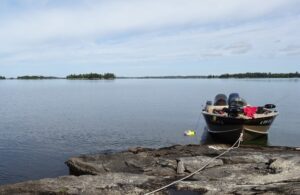
Boats are really not much different from automobiles… By the time I bought my first boat, way back in 1991, I was spending many joyous hours on the water on my favorite lake in Minnesota: Kabetogama. I was aware that life jackets were required by law to be available to all on board.
They were not, however, required to be worn. Having spent more hours than I can count running rental boats on Kabetogama with the mandatory life jackets on board – but never donning one – I was also acutely aware of the sudden squalls that were common on “Kab” in the summer months. And after all, I had earned a Water Safety Instructor badge, and I was in good shape and a very good swimmer. Also being a devout watcher of the weather, I always headed back to the cabin when I saw a storm developing.
PFDs & Foul Weather
Always, that is, until one summer when I wasn’t paying as close attention as I should have. As was always the case for this particular week, my mom was with me and seated in the front of the boat. Neither of us was wearing our life vests. It had been a rather sunny day and the lake was calm. Almost out of nowhere, the wind shifted direction and quickly began to blow with increasing velocity. Although I immediately headed for home base, I only had a fifteen-horse motor and the going got tougher by the second. Coming down the back channel, I was staring at four-footers cutting across my bow at an angle.
Although I instructed my 70-year-old mother to put on her life jacket, it was of the older Type II variety. You know the one: bulky, difficult and uncomfortable to wear, and also difficult to put on in a hurry. My mom couldn’t manage in the rough seas. She simply held on to the gunwales for dear life, and I was in no position to help. I had my hands full just keeping the tiller from escaping my grip.
Double Red Flags
Suddenly, coming down the side of a huge swell, my prop came completely out of the water. It was at that point – for the first time I can recall – I became concerned for our lives. The wind was howling and, in the distance, I saw the pair of triangular red flags flapping violently at the Voyageurs National Park Visitor Center. This would mean that the winds were in excess of 38 mph: officially a High Wind Warning/Gale Warning. Should the boat go over in this stuff, I wasn’t at all certain I could even save myself, let alone my mom.
The good news is that I managed to get the boat beached on a shoreline, near a trail I knew would allow us to walk back to the resort. During our silent hike, I vowed to never make those same two mistakes again (not paying attention to the weather and not wearing a life vest while in transit). The shot of brandy at the cabin steadied our nerves, but the memory of that storm has never faded.

Interesting Statistics… and Some Advice
Which brings me back to the very short article I saw in an April 2012 issue of Seaworthy magazine regarding what is now referred to as a Personal Flotation Device or PFD. I hope they won’t mind terribly if I quote directly from that piece:
“Most people are good swimmers and don’t want to be told when or where they should wear a PFD. A few years ago, a poll of Boat U.S. members found that 98% of the 10,000 respondents were opposed to a federal law requiring adults to wear PFDs on recreational boats. (There are federal and state laws requiring children to wear PFDs.) But at night, in rough conditions, in tippy boats, in cold weather, or if you don’t swim, a PFD makes a heck of a lot of sense.”
I have come to respect potentially dangerous situations to a much greater extent than I once did. Almost 85% of all those who drown as a result of a boating accident were not wearing a PFD. Smart thinking, good knowledge of boat handling and certainly a portion of luck allowed both me and my mother to make it home safely that day so long ago.
Personally, I don’t much care what the federal and state laws are. There is a more powerful law onboard my boat. It will never leave the dock until all persons, including the captain, are wearing their Coast Guard-approved PFD. There are never any exceptions.
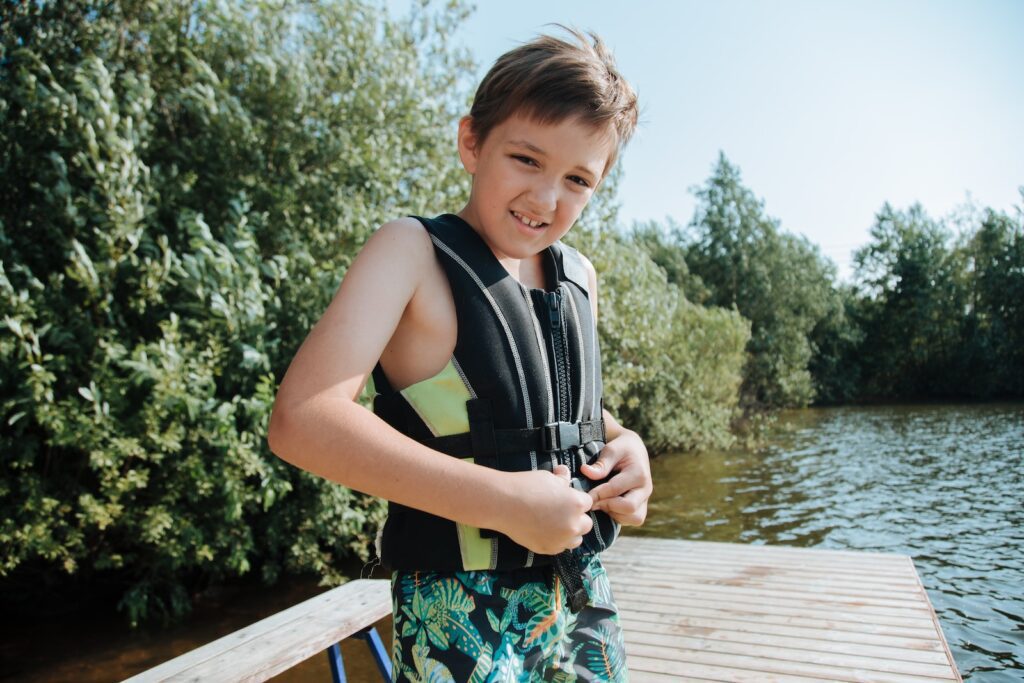
My advice is to make sure that you have these life-saving devices available for all… and that they are worn. They are no good to anyone if they are on the boat but stored away! When you make your routine safety inspection (whether it be before every outing, or once a year in the spring), make sure that your boat is equipped with PFDs. They are truly life savers. Read more information about PFDs in a downloadable/printable brochure.
Additional Resources, Related Links & Products
- Onyx A/M-24 Automatic/Manual Inflatable Life Jacket, U.S. Coast Guard Approved, Low Profile, Compact Design (Amazon)
- Outward Hound Granby Splash Orange Dog Life Jacket (Amazon)
- Life Jackets & PFDs at West Marine