One Last Tour
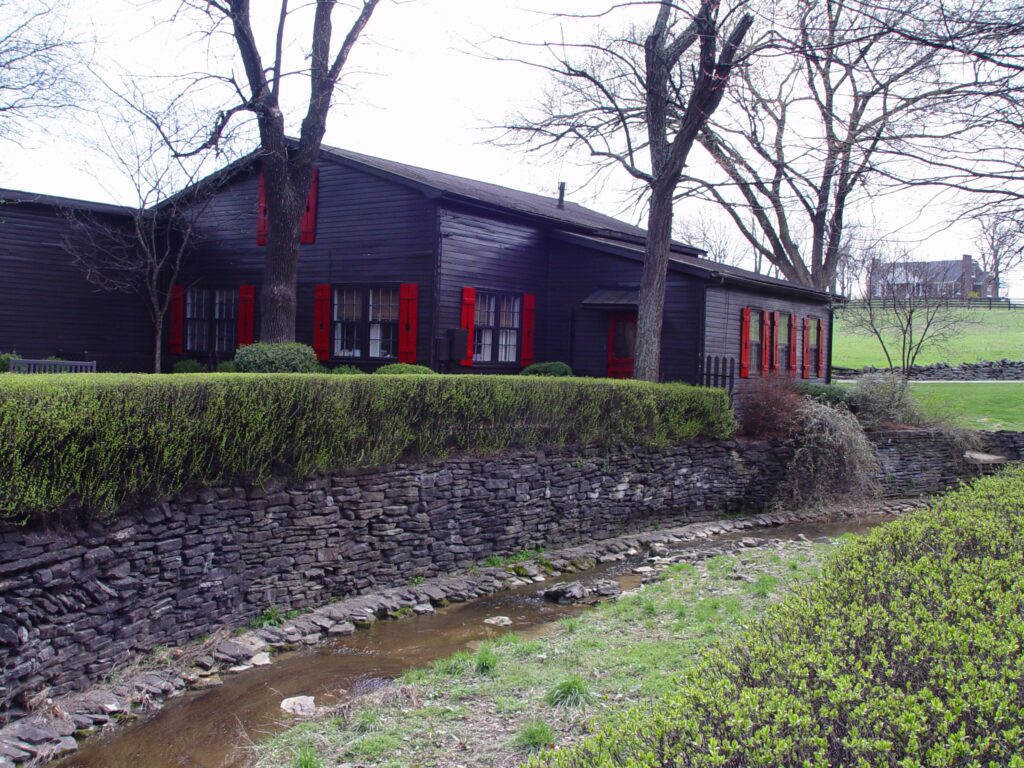
Our last stop on the Kentucky trip was Bardstown, Kentucky. But just about twenty minutes to the south of it – and not far off our intended path – was another landmark. I just couldn’t resist the temptation of a visit so I could compare Maker’s Mark to the other distilleries which I had toured and bourbons I had sampled. Located in Loretto, Kentucky (population about 650) on the banks of Hardin’s Creek, Marker’s Mark is arguably one of the prettiest spots at which to locate a distillery.
(This page may contain affiliate links. See our disclosure about affiliate links here.)
Makers Mark
Brown-painted buildings (to signify the amber color of their bourbon) and red shutters (signifying the red wax seals on the bottles) with cut-outs in the shape of a Marker’s Mark bottle add to an almost quaint setting that is immediately friendly and inviting. From its humble beginnings as a grist mill/distillery in 1805, Maker’s Mark is proclaimed to be the oldest working bourbon distillery in the nation, also receiving the distinction of being named a National Historic Landmark in 1980.
Whiskey making has been in the blood of the family since 1784, when Robert Samuels, a Scottish-Irish Immigrant, arrived in Kentucky and started making Whisky, mostly for himself and friends. In 1840, T. W. Samuels (Robert’s grandson) built a commercial distillery at Samuels Depot in Nelson County, Kentucky and used a recipe that would be passed through six generations.
Somewhere in the late 1940’s to early 1950’s, Bill Samuels Sr. (Robert’s great, great, great grandson) decided to (1) reopen the distillery that had been closed by Prohibition, (2) move it to Loretto, (3) produce a new and distinguished bourbon and (4) set fire to the six-generation old family recipe (the new version he discovered in the kitchen — not the distillery — by baking bread using the gentler flavored red winter wheat instead of rye).
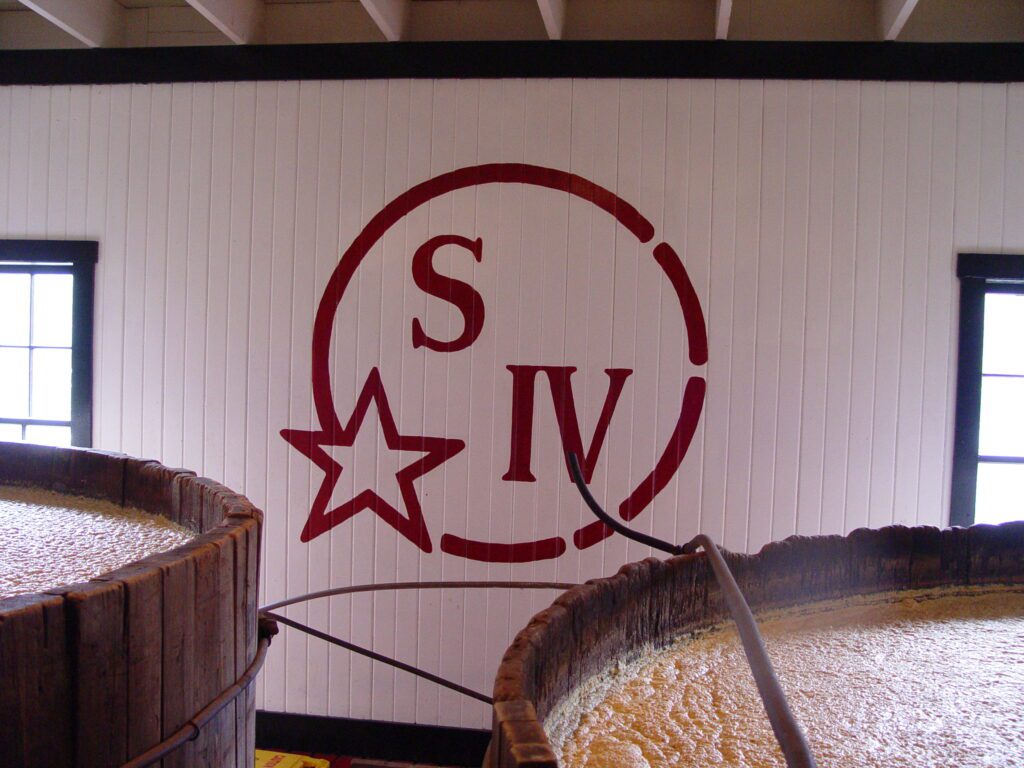
Bill’s wife came up with the idea of placing a symbol – a “mark of the maker” – on the bottle as a tribute to the excellence of the maker and character of the new-recipe bourbon. And thus, the name, Maker’s Mark, was born at the distillery of the same name in 1953.
The Tour
The tour of the facility was similar to others we had taken, but as is the case with all bourbon distilleries, each has one or more twists in the process that set them apart from competitors. Maker’s Mark is definitely no different.
Although they too use cypress wood fermenting barrels (originals, with some planks over 100 years old) and copper distilling apparatus, they use an old-style roller mill to crush the grain. They propagate their own yeast, use limestone spring water from their own lake and — from their own web site – “red winter wheat from specially selected small farm cooperatives, all of which are located within the limestone geology near the distillery. This wheat gives our whisky its soft, mellow taste.”
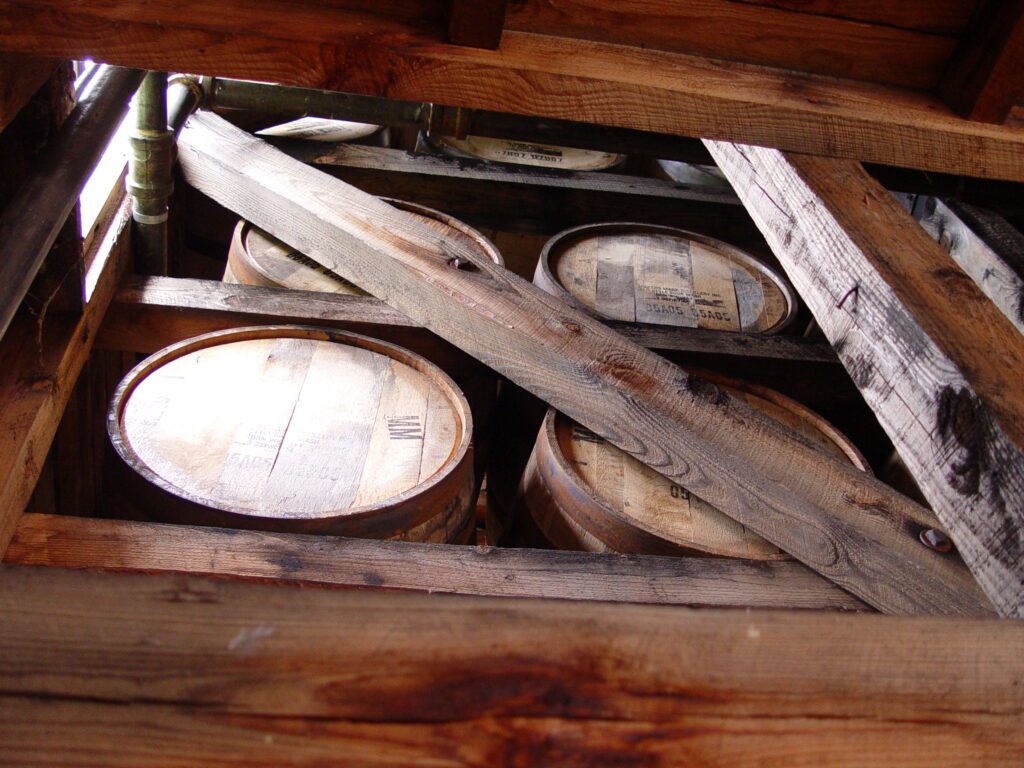
Maker’s Mark prides itself on being a small distillery that makes small batch bourbon, totally by hand. Even the bottle’s label was originally penned by hand by Bill’s wife (an amateur calligrapher).
The Gift Shop
At every step in the process, it can truly be said that this bourbon is hand-made, right down to hand-dipping every bottle produced. And at the end of the tour, we had the opportunity to sample the results of Bill’s special recipe. And I truly liked its mellow taste.
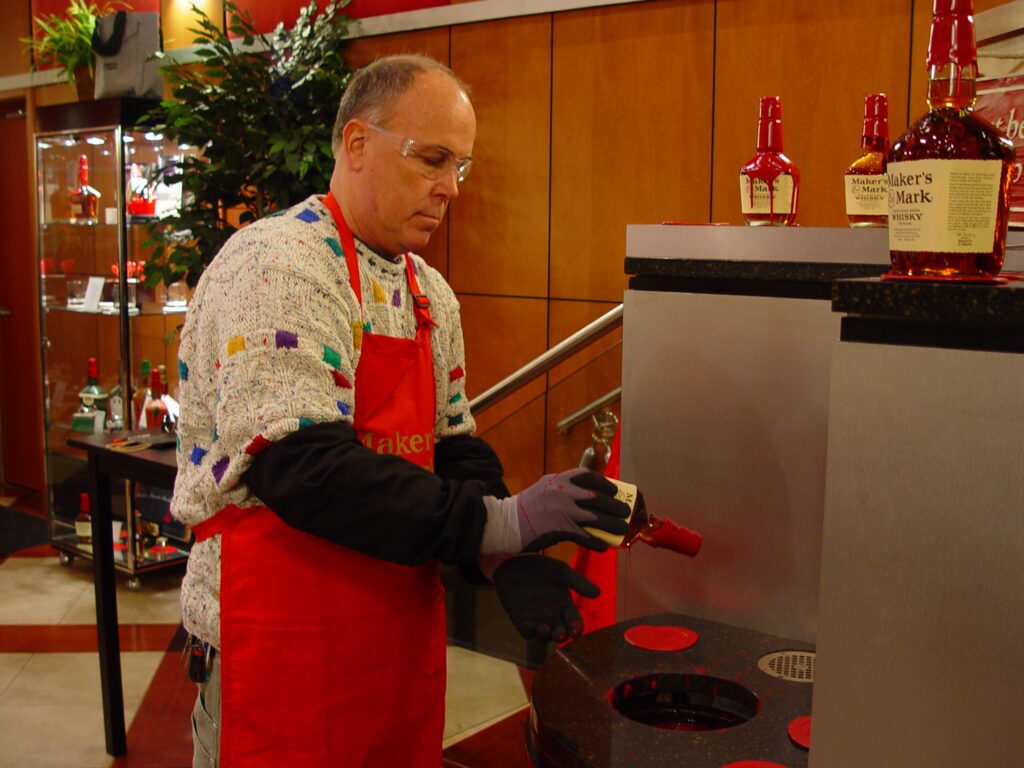
So, I bought a bottle in the gift shop and hand-dipped it myself, sealing the top with the trade-mark red wax found on all bottles of Maker’s Mark. Dipping that bottle was almost as exciting as the excellent bourbon I would later taste!
There is another distillery (Heaven Hill) not far away in Bardstown that one can tour. Actually, there are many interesting things to do and see in Bardstown and the immediate surrounding area. Unfortunately, there was insufficient time for a stop there…
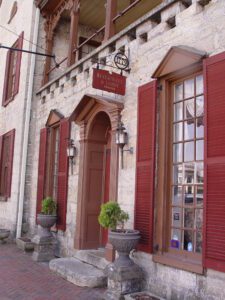 But it had been a very busy four days for us and our preference at this point was to take some time to unwind and digest what we had seen and done. We stopped briefly at the Old Talbott Tavern (It is perhaps the oldest western stagecoach stop in America), and the Jailer’s Inn Bed and Breakfast right next door. Part of that building was still in operation as a jail, as recently as 1987!
One Last Taste
The Tavern supplied us with what was to be my last bourbon “tasting” on our trip. The remainder of the day and evening proved uneventful, as our scheduled dinner on My Old Kentucky Dinner Train fell far short of our expectations. We retreated to the General Nelson Inn in town and, as had been the case for the last several nights, fell quickly asleep.
The drive back to the Chicago area seemed short. Conversation turned repeatedly to our many stops and event-filled days. I now know that I must return to Kentucky, as there is so much more to see and do.
I wish to leave you all with one final observation that was reinforced at every place we visited, and at every stop we made. Kentucky is without a doubt populated with some of the nicest, most sincere, gracious and polite people anywhere I have ever been. They are the main reason that I would go back at the drop of a hat. My advice? Discover the beauty, excitement and hospitality that are the distinctive trademarks of the great commonwealth of Kentucky. Plan your trip today.
Special Thanks to
- Marge and Chris at the Kentucky Department of Tourism, without whose hard work and help this trip would not have been possible.
- Niki and Mary at the Lexington Convention and Visitors Bureau
- Angela at Buffalo Trace Distillery — your enthusiasm and zeal must be contagious!
- Steve at Woodford Reserve
- Nicole at Maker’s Mark for the great tour
- Amy and Zack at Red River Outdoors for your patience with rookie climbers
- The entire state of Kentucky for a great time!