
I’m not really sure where the name pan-fish came from. My sense is that they were just small fish that were scaled, gutted and gilled and tossed into the fry pan. They go by myriad names – like bream, sunfish, blue bream, sun perch, blue sunfish, sunfish, sunperch, coppernose, copperbelly or bluegills – and are overlooked by many due to their diminutive size. As a kid, I caught many from the river that ran through our town, but never gave a thought to eating them.
Warning: This article contains images of fish filleting that some readers may find disturbing.
About ten years ago, I was taken to a small lake for the singular purpose of catching ‘gills for a fish fry. I was pretty skeptical until, among a four-boat group, we returned with over 150 of the little guys in about an hour’s worth of fishing. Filleting them was another matter: the size and anatomy of the fish make filleting them something of a chore. But when I tasted the results, it was I who was literally hooked.
(This page may contain affiliate links. Read our disclosure about affiliate links.)
Good for a Fish Fry
On my annual journey north to vacation in Minnesota, I now make a point of setting aside one day just for bluegill fishing. We always manage to bring back 50 or 60 for a fish fry. The best ones – if you can locate them – are about the size of your hand. I struggled through filleting my first several; a friend then showed me how. It’s not difficult, but it does require some time because you need a lot of fish for a good fry.
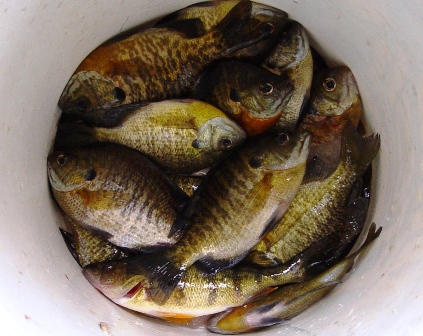
By the way, if you have a great spot for catching blue gills, it is a tremendous way to get a kid hooked on fishing. The action can be fast and furious when they start to hit, and it can be tough to keep your line in the water. Sometimes the boat can be anchored, and bobbers can be used. Or, if the location is right, all the fun can be had from shore!
Step-by-Step Instructions for Filleting Bluegills

Step 1
Start by placing the fish belly side towards you with the head of the fish on your left. (Again, this method is for a right-handed person.) Make the first cut down and into the fish just behind the pectoral fin. This cut is also illustrated in the Filleting Bass article.

Step 2
Then, rotate the fish through almost 180 degrees so that the dorsal or back side of the fish is facing you and, starting at the back of the head, use the tip of the knife to cut through the tough skin and to a point that is located just about at the end of the dorsal fin. (This is almost identical to the cut one would make along the back of a smallmouth bass when filleting it (see my Filleting Small Mouth Bass article). The cut here will not be very deep – you only need to cut to the point where the ribs attach to the backbone. Be careful not to cut through the ribs.

Step 3
The point at the end of the dorsal fin is approximately where the rib cage stops. Now push the knife blade all the way through the fish and out the belly side. Make sure the knife blade stays above the backbone/spine of the fish. Maintaining downward pressure on the flat side of the knife, continue cutting back toward and finally through and out at the tail. At this point, the fillet is only attached at the rib cage and the belly.

Step 4
Now, lifting the small slab of the fillet, use the tip of the knife to begin to separate the meat from the rib cage. I find it easier to start at the rear of the rib cage/back of the fish.
Cut downward, following the curve of the rib cage, and gradually working your way forward towards the front of the rib cage. The curve of the rib cage is rather steep and therefore somewhat difficult to follow – as always, a sharp knife is a must, and practice makes perfect. Larger bluegills make this process a bit easier.

Step 5
The last cut to make will be through the belly: the one that allows you to detach the fillet from the carcass. Repeat the process for the other side of the fish. You may find, as I do, that one side always seems to be a bit easier than the other – especially at first.
Slide the knife between the skin and meat to remove the skin (see my article on Removing the Skin from Fish Fillets) and what is left should be a nice little boneless fillet. If the ‘gills are fairly large, four to six fillets per person will do rather nicely for a fish fry… although it depends upon how hungry you are after cleaning all those fish!
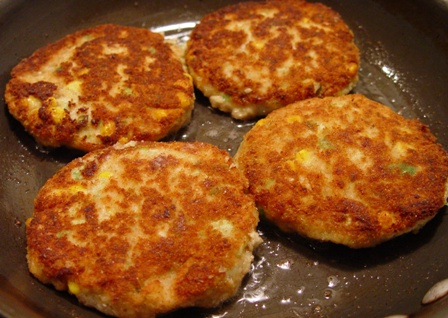
I even use bluegills now to make what I call Kab Cakes (almost better than Crab Cakes). Kab Cakes are a great way to use your catch of bluegills but can be made with any combination of fish. (They are very similar to crab cakes, but use freshwater fish instead of crab.)
The cakes have an outstanding flavor, are easy to make, and are perfect for breakfast, lunch, dinner or even as an appetizer. The best part is that the recipe can be made in advance and then assembled at the last minute. View Kab Cakes / Fish Cakes recipe.
Additional Resources, Links & Products
- Zwilling J.A. Henckels 7 inch Fillet Knife (Amazon) – I prefer to use this knife for filleting bluegills. The longer, more flexible blade helps to get more meat around the rib cage.
- Galvanized Steel Wire Collapsible Fish Basket (Amazon)