As I stated in my very first article on the topic: “Winter sports are surely not for the faint of heart. But if the hustle-bustle rat race and other stresses have got you feeling that you want to scream, my suggestion would be to head north for a little getaway.” Seems like it was time to follow some of my own advice…
Until just a few years ago, I was strictly a “soft water” fisherman — meaning that I preferred to be on the water in a boat when the water was in its liquid form and the temperatures allowed for T-shirts. Even so, I have written a couple of articles chronicling an ice fishing trip or two that I really enjoyed.
Remedy for Cabin Fever
And when cabin fever set in again recently, I started to look around for places that offered ice fishing from heated shanties so that Heidi and I could do some fishing. Although there may be numerous places out there that offer this type of thing, I quickly discovered that actually finding one was far more difficult than I had anticipated. Suddenly I realized that the same forces that finally convinced me to get my own boat were now pushing me to get my own ice fishing equipment: cost and convenience.
Now, I may have been bitten by the ice fishing bug – almost ready to secure my own gear and allowing for forays onto the ice at any time I wish – but I certainly have much to learn before I head out to my local sporting goods store with checkbook in hand…
However, a recent trip to Lake Delavan, Wisconsin with a knowledgeable and easy-going local guide added some valuable insight into the sport and some necessary insight into the proper equipment. He also helped to provide some fun and a few bluegills for dinner.
Old Haunt and Favorite Dining Spot
John Reddy, of Reddy Guide Service, was our choice for a number of reasons, not the least of which was a very prompt return of my phone call and a polite demeanor during the conversation. Delavan Lake also provided a place fairly close to home.
Due to the proximity, we could have easily fished and returned home on the same day. But fishing Delavan also provided the only excuse I needed to stay at an old haunt — Harbor Shores on Lake Geneva — and to visit one of my favorite dining spots: The Mars Bar and Restaurant.
Reddy is a native of the Delavan area and has an extensive knowledge of the area lakes, has all the gear needed for every group configuration and, as we quickly found, is very easy going. The drive was an easy one of about ninety minutes early on Saturday morning; we met John at about 12:30pm.
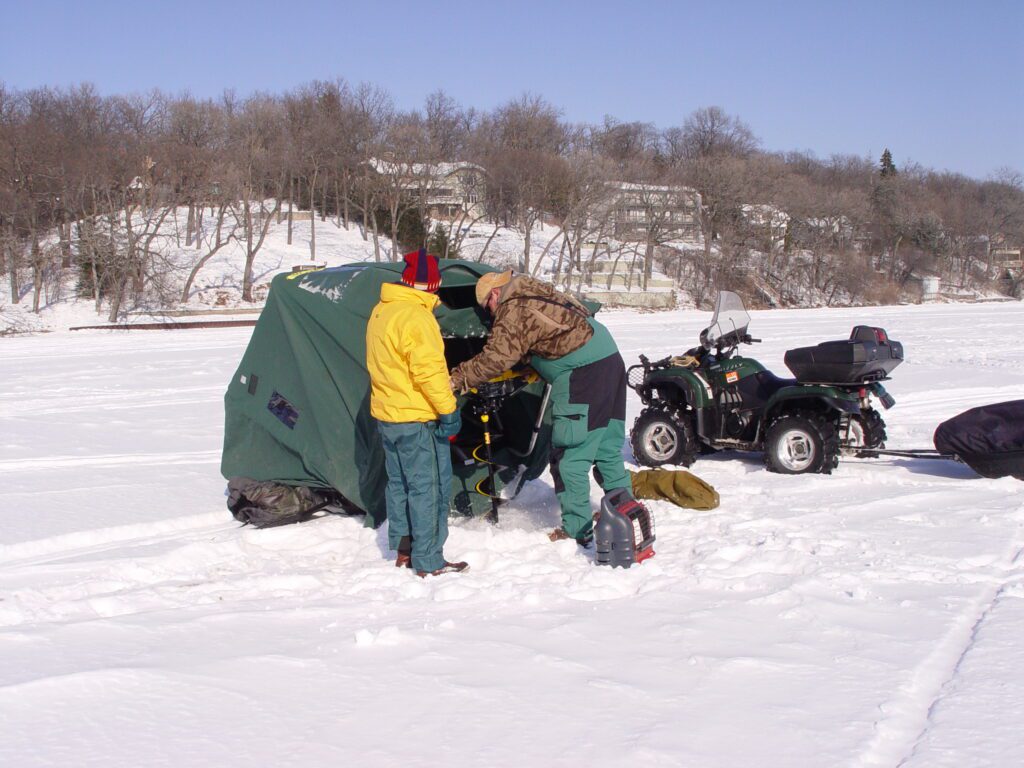
We were in luck that day, as the temperature had finally climbed out of the deep-freeze and was headed for a high close to 30 degrees. I was first to head out to the lake on the back of an ATV, towing an Otter II ice shelter behind us. Strapped to the front of the machine was a new, 10-inch bore ice auger.
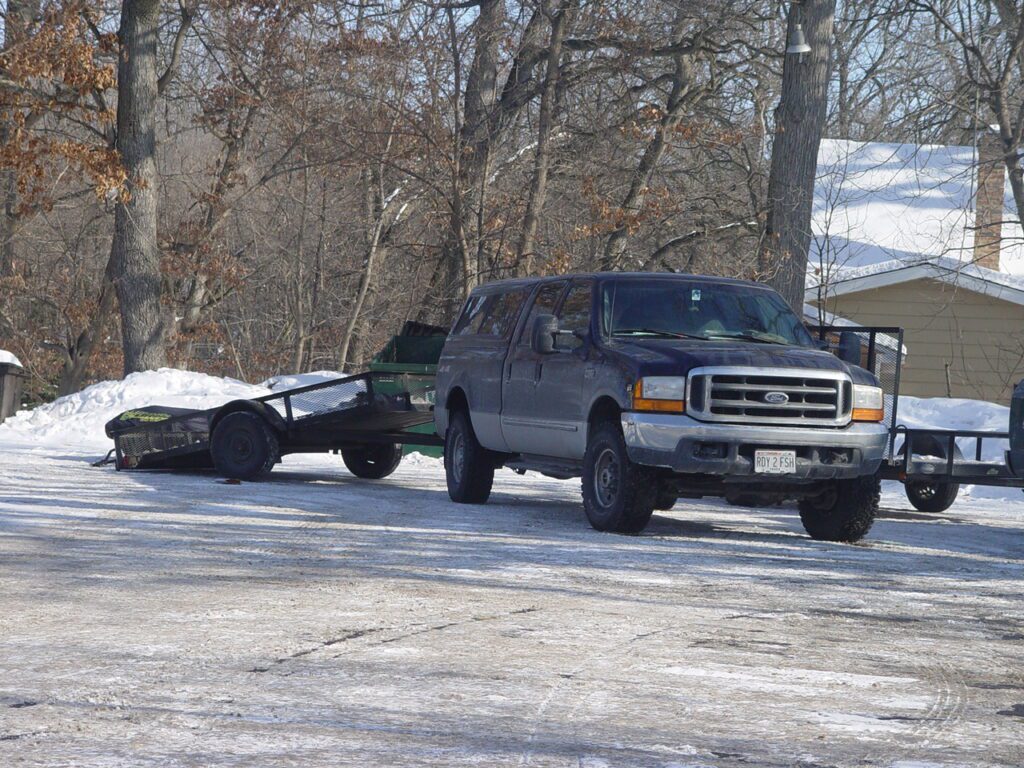
The wind on my face produced a bit of a sting, but it was not the kind of cold that makes one want to change one’s mind about the day ahead. The end of the lake appeared as an ice-shanty city, densely populated with a wide variety of equipment – from the single fisherman sitting on a bucket, to those in permanent wooden shacks.
Targeting Bluegills
In less than five minutes, we arrived at a spot that our guide had chosen for a start; away from the masses and on the other side of the lake. The shelter was up in minutes and a “Mr. Heater” was glowing warmly in the tent as John headed back for Heidi. The pair arrived back shortly and John went about drilling two holes in the 18″-thick ice for fishing inside the shelter.
We were concentrating on bluegills for the moment and the set-up was simple: a tiny 1/64th oz. jig tipped with a red spike (grub) fished just off the bottom. No sooner were we happily zipped back into the shelter, than John set about drilling a half-dozen holes around the perimeter and setting tip-ups for northern pike that might be cruising through and looking for an easy meal.
It wasn’t long before I heard: “We’ve got a flag up!” I exited the warmth of the shelter and headed toward where John was standing. Watching as the small spool was reeling off yards of line, John gave me some brief instruction as to how to set the hook and play the fish, then gently removed the board from above the hole and the fight was on.
Who Needs a Pole?
This was definitely a first, as I had never hauled in a fish by hand — without the aid of a fishing pole! Suddenly, the head of a decent-sized pike appeared and I hauled him quickly up through the ice. Unfortunately, he was not the required size of a keeper on Delavan — 32″ — and we released him back to the frigid world beneath the ice.
Heidi meanwhile, had not received any bites and upon my return to the warmth of the shelter, we both decided to share a sandwich — and of course a beer — that she had brought along. The wind had begun to blow fairly hard; the tent flapped and shook but we were secure and toasty warm. By now — fish or no fish — the decision to purchase our own ice shelter was pretty much made.
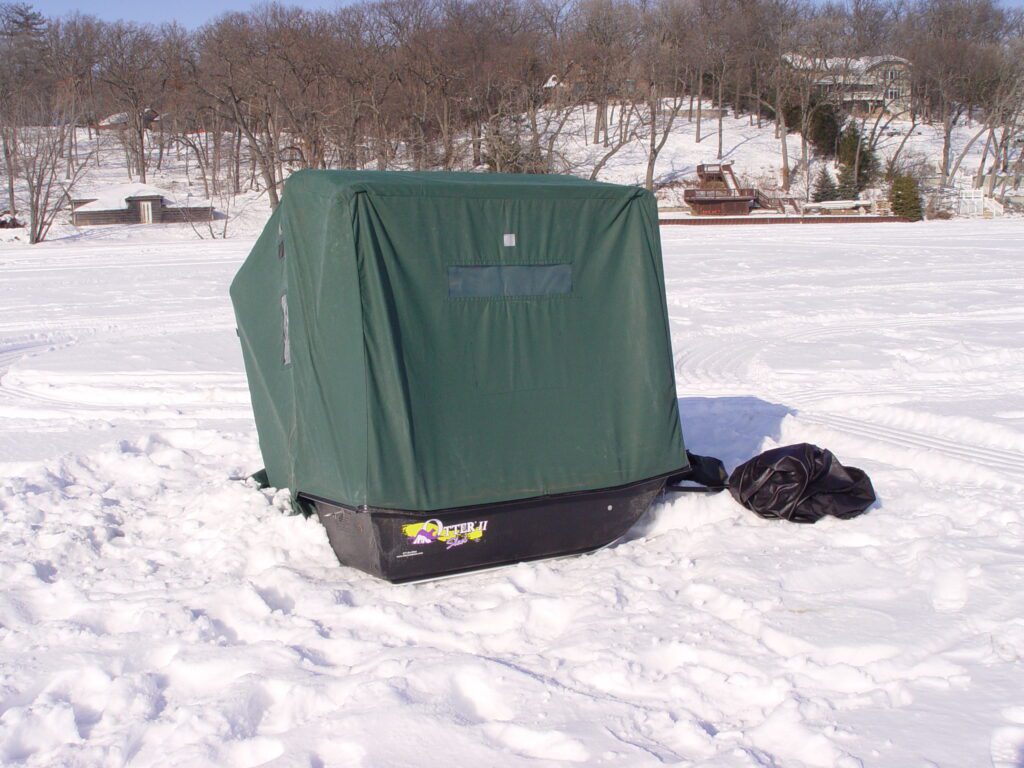
John did decide to move the shelter to water that was a bit deeper and, upon doing so, the fish began to bite. Most were small and had to be tossed back. But we did manage to catch about eight that were big enough to keep; they ultimately came home with us and we enjoyed a nice blue gill dinner. (Not sure how to fillet bluegills? View my step-by-step instructions.)
Throughout the remainder of the afternoon, from the small windows of our shelter we watched snowmobilers as they zoomed past, and we occasionally hurried outside as the now familiar phrase “We’ve got a flag up!” was heard several more times.
Fading Daylight
The pike were timid that day and as close as we got to another one was to simply watch, as a monster-sized specimen hung suspended and uninterested within inches of our bait. The sun had begun to dip below the tree tops as John pulled in the tip-ups, secured the equipment and took Heidi back to the car.
In the fading daylight, the scene was almost surreal: The charcoal grills were being fired up and the ice fishermen were about to partake of dinner… almost like a tailgate party. Even as the temperature headed back into the teens, no one seemed to mind. It may as well have been the 4th of July. The only thing different was that the party would have been on shore instead of on the ice!
We paid and thanked John for his efforts and talked about a return trip for some of the lake trout that he said were lurking in the deep waters of Lake Geneva… a trip for another day. And speaking of Lake Geneva, we headed back to the Harbor Shores on Lake Geneva there for hot showers before heading out to the Mars Bar for fish dinner. It was as good as ever!
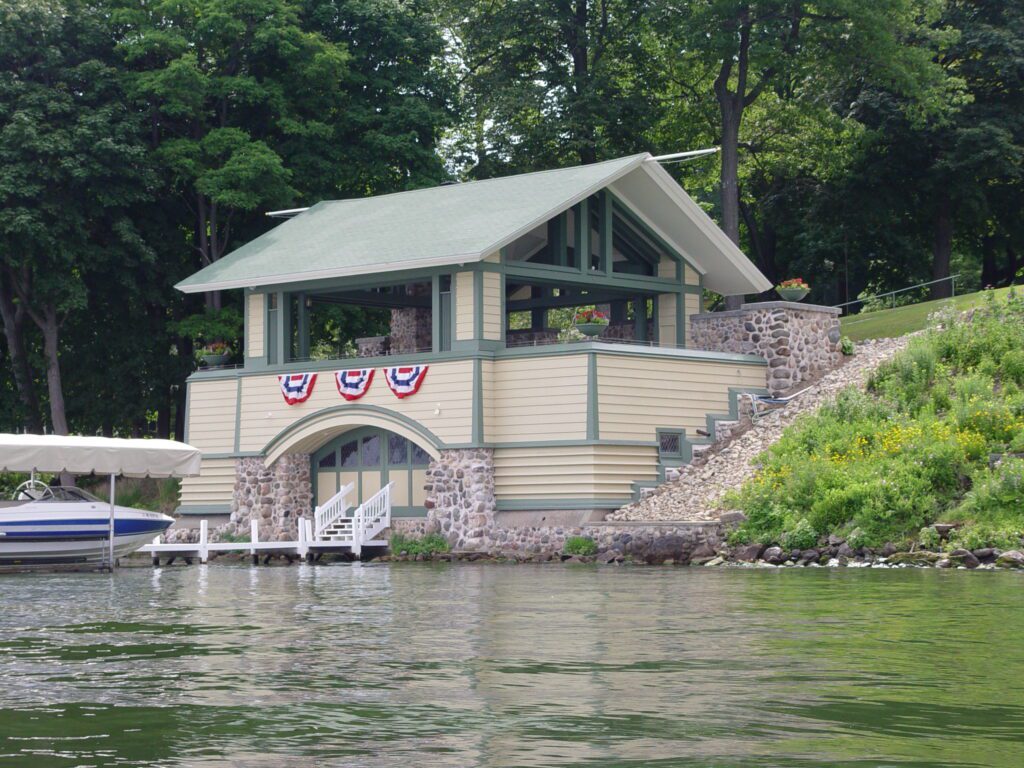
By the way, if you’re ever on Lake Delavan, take a moment to look at some of the lake homes there. Five of them were designed by architect Frank Lloyd Wright! The boat house picture below is part of Penwern.
Best of luck; I hope to see you… On the Lake!
R. Karl